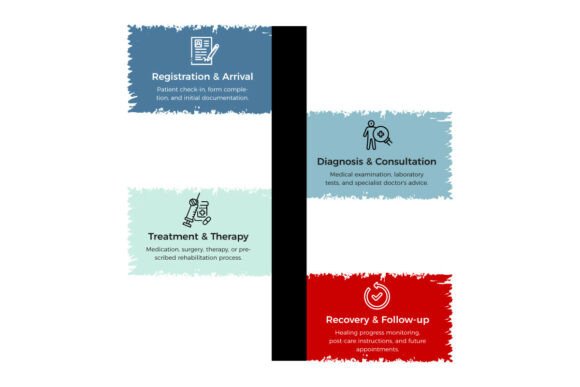
Healthcare Patient Care Process Flow
Whether you're designing a clinic’s onboarding system, building patient education materials, or preparing a presentation for healthcare administrators, having a clear, accurate visual of the Healthcare Patient Care Process Flow makes all the difference. It’s not just about drawing arrows between “Admission” and “Discharge.” It’s about representing how people, systems, and decisions interact across time—safely, consistently, and with empathy.
Why a Well-Structured Flow Matters More Than You Think
In real-world settings, care doesn’t happen in isolation. A patient’s journey may involve triage, lab coordination, specialist referrals, insurance verification, discharge planning, and follow-up—all while staff manage shifting priorities and regulatory requirements. A generic flowchart won’t cut it. What works is a Healthcare Patient Care Process Flow that reflects clinical logic, compliance touchpoints (like HIPAA documentation steps), and human-centered transitions.
That’s where a professionally designed, editable asset becomes practical—not decorative. When you use a ready-made Healthcare Patient Care Process Flow, you’re not copying a diagram. You’re adopting a tested structure that aligns with common care models: from acute episode management to chronic disease pathways, and even telehealth-integrated workflows.
What You’ll Get—and Why Each File Type Serves a Real Purpose
This package includes three complementary file formats—each solving a distinct need:
- AI file (Adobe Illustrator): Your editable source. Resize without pixelation, recolor to match your brand palette, relabel steps (“Pre-Visit Questionnaire” instead of “Intake”), or integrate with EHR screenshots. Ideal if you’re customizing for a specific department—say, oncology navigation or pediatric behavioral health screening.
- EPS file: A vector standard compatible with most professional design and print tools—even outside Adobe ecosystems. Use it when handing off to a marketing agency, printing large-format posters for staff training, or embedding into PDF policy manuals where crisp line work matters.
- Preview JPEG file: A high-resolution, ready-to-use image. Drop it into slide decks, internal wikis, or patient-facing handouts instantly. No software needed. Great for quick validation—showing stakeholders the flow before investing time in customization.
Together, they remove friction—not just in design, but in communication. A nurse educator can tweak the AI file to highlight sepsis protocol triggers; a hospital marketer can drop the JPEG into a community outreach email; a quality improvement team can print the EPS version for a process-mapping workshop wall.
Who Benefits—and How They Use It
Clinic managers and operations leads use the Healthcare Patient Care Process Flow to identify bottlenecks—like where patients wait longest or where handoffs between departments create delays. With the editable AI file, they annotate actual cycle times or add icons showing electronic vs. paper-based steps. That turns a static image into an improvement tool.
Health educators and patient advocates adapt the flow to simplify complex journeys—replacing clinical jargon with plain language, adding multilingual labels, or inserting illustrations for low-literacy audiences. The vector files scale cleanly for brochures, mobile apps, or video storyboards.
Students and instructors rely on clarity and accuracy. A well-structured Healthcare Patient Care Process Flow helps learners visualize interprofessional collaboration—how a pharmacist’s medication reconciliation step fits between nursing assessment and physician order entry. Instructors use the JPEG for quizzes; students modify the AI file for capstone projects.
Freelance designers and content creators serving healthcare clients appreciate not starting from scratch. Instead of reverse-engineering clinical logic, they begin with a foundation grounded in real-world care sequencing—then layer in client-specific branding, data visualization, or interactive elements.
Real-World Use Cases That Go Beyond the Obvious
A rural health center used the Healthcare Patient Care Process Flow AI file to map its new same-day mental health access pathway. They replaced generic “Consultation” with “Brief Behavioral Intervention + Warm Handoff to Therapist,” added a decision diamond for social determinants screening, and color-coded steps by staff role. That became the basis for staff training—and later, a grant application demonstrating process rigor.
A medical device startup embedded the JPEG version into investor pitch decks—not as decoration, but to show how their remote monitoring tool integrates at the “Post-Discharge Follow-Up” node. Investors responded more strongly to the visual logic than to bullet points alone.
An academic publisher licensed the EPS version to include in a textbook chapter on care coordination. Because it was vector-based, it retained sharpness at any print size—even in grayscale—and met accessibility contrast standards out of the box.
What This Isn’t—and When to Look Elsewhere
This Healthcare Patient Care Process Flow is intentionally flexible—but not infinitely customizable. It assumes a foundational understanding of standard care phases (e.g., intake, assessment, intervention, evaluation, transition). It doesn’t include proprietary EHR interface mockups, nor does it cover highly specialized flows like ECMO management or trauma bay resuscitation—those require clinical domain expertise beyond a general-purpose template.
If your goal is deep workflow automation—mapping API triggers, database queries, or real-time alert logic—you’ll need developer collaboration and system-specific documentation. This asset supports the human and process layer, not the technical implementation layer.
Also, while the flow reflects widely accepted best practices (e.g., shared decision-making checkpoints, timely discharge summaries), local regulations, payer rules, or facility policies may require adaptation. Always validate with frontline staff before rolling out.
Getting Started—Without Overcomplicating It
You don’t need design experience to benefit. Start with the JPEG preview: paste it into a document and ask yourself—“Where would my audience get confused? Where do we actually deviate from this?” That simple audit often reveals opportunities no software could spot.
Then open the AI file—not to redesign everything, but to adjust one thing: maybe change “Registration” to “Pre-Visit Registration & Consent,” or add a note icon beside “Lab Orders” linking to your turnaround time SLA. Small edits make it yours.
Finally, keep the EPS file archived for future needs—like when your organization updates its brand guidelines or expands service lines. Its resolution independence means it stays useful for years, not months.
A thoughtful Healthcare Patient Care Process Flow isn’t about perfection. It’s about reducing ambiguity—so teams align faster, patients understand better, and improvements become visible, measurable, and sustainable. With the right files in hand, that clarity stops being aspirational—and starts being operational.